

Challenging Tri-Share
There's a difference between "this isn't the whole solution" and "this may not work well enough to continue doing it."

If you are not steeped in the child care policy and advocacy world, you are unlikely to understand how controversial the title of this post is. Take my word for the moment. I’m going to try to tread carefully here, because this is one of those topics where I am on the other side from people I deeply respect, deeply trust, and for whom I am deeply grateful. That said, I do believe one of my useful roles is to help illuminate controversial topics, hopefully in ways that move us toward better policy and better conversations.
So let’s start at the beginning.
What is “Tri-Share”?
Tri-Share refers to a program in which employers, employees, and the government split the cost of a child care seat three ways – usually 1/3, 1/3, 1/3. (Hence, Tri-Share. Different states call it different names, like ‘employee child care assistance program,’ but when I talk about Tri-Share in this piece I am referring to the underlying model.) There is usually an income-eligibility limit for families which is considerably higher than the limit for getting state subsidy. Tri-Share was first piloted in Michigan starting in 2021, and has since become quite popular: the model has spread to North Carolina, West Virginia, Kentucky, Missouri, New York, Virginia, part of Indiana, and is under active consideration in many other states. There is also a bipartisan bill in Congress that would start a federal pilot.
The logic is straightforward: this offers employers a way to contribute to their employees’ child care without having to bear the full cost, offers government a way to help families that make too much money to be eligible for subsidy systems without breaking the bank, and of course offers families a two-thirds discount on their child care bill. As an extra bonus, Republican lawmakers tend to like the idea, so it’s movable for red states in a way lots of big-swing child care policies aren’t.
Sounds reasonable! What’s the problem?
You might expect me to say that the problem is this initiative leans on employers as a child care solution, which I have vocally argued against — wrote a whole report arguing against, in fact! — because, fundamentally, running child care through employers stands opposed to making child care a right. Or perhaps you’d expect an argument that Tri-Share doesn’t actually put more money into the desperately underfunded child care system, it just replaces some percentage of inadequate parent dollars with government and employer dollars. These are indeed objections I have, but they’re actually not what I want to focus on, because they’re not Tri-Share’s fatal flaw.
The problem is that Tri-Share doesn’t scale, because employers just don’t appear compelled to participate in large numbers.
In Michigan, after about five years (as of March 2026), the program currently serves around 1,000 kids in about 800 families with roughly 300 participating employers – out of a young-child population of ~650,000.
In North Carolina, after a year and a half (as of March 2026), the program currently serves 46 kids in 27 families with 20 participating employers — out of a young-child population of ~700,000
In Kentucky, after around three years (as of June 2025) the program was serving 150 kids in 108 families1 — out of a young-child population of ~265,000.
Those numbers are low enough on their own, but you have to understand an important fact: In many cases, close to HALF of the employers that participate in Tri-Share are child care programs!2 What that means is that child care centers are signing up as employers so that they can offer more affordable child care to the kids of their teachers. Many child care programs already offer employees discounts –– say, 25% -– off care for employees’ kids, which is useful because the child care workforce tends to be younger and lots of them have little kids. That discount, though, still leaves child care slots out of reach for many educators.3 Sign up for Tri-Share, and the existing employee discount is plussed up by government funding.
Let me hasten to say there’s nothing nefarious happening: child care programs are employers, they’re eligible, they know about Tri-Share, so why wouldn’t they sign up? Here’s an example of what I mean, from a February 2025 article about North Carolina’s program:
Though all types and sizes of businesses are eligible, the majority of employees participating are child care providers themselves, Scott said.
That means the child care program is both the employer and the provider offering the care. Kiersten Mahaffy, strategic partnerships coordinator of Martin-Pitt Partnership for Children, said child care programs’ participation not only helps lower the cost for parents, but also strengthens the system itself.
“If the provider and employer can be one, the money is going straight back into child care,” Mahaffy said. “So not only are we helping the parents, but we’re also helping our educators, which in turn helps child care providers. So overall, it just helps child care in general.”
As it happens, 13 of the Tar Heel State’s 20 currently participating employers are child care programs, and it is surely helping them. But, let’s be clear: that’s not the way Tri-Share is sold! And when you slice the participant numbers in half and just look at the non-child-care-employers, it becomes starkly apparent just how meager the uptake is. That’s not an indictment of those working on Tri-Share, nor an indictment of trying to engage businesses as child care stakeholders, nor an indictment of public funding for the child care sector writ large — anyone using this critique to make any of those arguments is acting in bad faith. The facts simply mean that this particular model appears to not work very well.
Moreover, if one’s policy goal is to make child care affordable for the kids of child care employees – which is absolutely a worthy goal, since when you attract and retain child care educators they are serving many children from the community – then Tri-Share is an awkward choice. Much better is to pursue a distinct model from Kentucky which simply makes child care essentially free for child care educators by giving them automatic eligibility for the state’s child care subsidy system. Kentucky has helped over 5,000 early educators this way, and other states have followed suit; that policy has legs, but it’s not Tri-Share and the two shouldn’t be conflated.
What would Tri-Share proponents say?
I’ll want to be as fair as possible, so I’ll largely let them speak for themselves. As to why uptake is so low, there are many potential reasons given across articles, reports, and my own conversations: employers are slow to learn about Tri-Share; the administrative process of signing up is too burdensome; employers don’t trust that a ‘pilot’ won’t go away after a few years and leave them holding the bag; the income thresholds are too low, so some would-be participating employers don’t have any employees that are eligible.4 Others will emphasize to the legitimately excellent impacts that Tri-Share has had for families that do participate.
What about the bigger picture? Linda Smith, an esteemed child care policy expert, recently co-authored a positive report on Tri-Share. She argues, in what I think is a fair summation of that side of the debate:
Tri-Share is a targeted workforce support strategy designed primarily to help working families who earn too much to qualify for child care subsidies but still cannot afford market-rate care. Legislators should treat Tri-Share as a gap-filling affordability tool, a workforce recruitment and retention strategy, and a pilot for testing shared responsibility financing, rather than a universal child care solution.
Smith further asserts that:
Advocates are right to insist on broader public investment in child care. Tri-Share does not replace that goal. But dismissing Tri-Share because it is not universal misses its value. Tri-Share helps answer questions the field has struggled with for years, questions a federal pilot can help answer.
The bottom line is this: Tri-Share should be viewed as a policy laboratory—one that offers practical lessons about shared responsibility, affordability, and sustainability. For advocates committed to building a stronger, more inclusive child care system, supporting a federal Tri-Share pilot is not a retreat from public responsibility. It is a strategic step toward a more realistic and resilient financing framework.
If the goal is to expand access, strengthen supply, and recognize child care as essential economic infrastructure, then Tri-Share deserves a place in the national conversation.
Indeed, this is perhaps the most common defense of Tri-Share: it’s just one tile in the child care policy mosaic. Take this, from a Nov. 2025 EdSurge article entitled “More States Adopt ‘Tri-Share’ for Child Care, Even As Some Question Its Merits”:
Seemingly no one involved in Tri-Share views it as the answer to the child care crisis. Quite the opposite.
Kristina Bajtka, director of Tri-Share for United Way of Northwest Michigan, which acts as the statewide administrative partner for Michigan’s Tri-Share, is quick to remind that Tri-Share was designed to be a workforce development program, removing a key barrier to economic growth.
“Was it created to fix child care? No. It’s not the easy button,” Bajtka says. “Is Tri-Share alone going to solve the child care crisis? Absolutely not, and Michigan never said it would.”…
…Bajtka, Aull and Sutherland, along with others interviewed for this story, all describe Tri-Share as “a piece of the puzzle,” not the complete jigsaw.
“This is not the be-all, end-all to help address child care,” says Aull of Kentucky. “But absent some major expansion of the federal child care program, or major investments at the state level, this is a really targeted intervention that can help families.”
In many ways, though, this is somewhere between a misunderstanding and a feint: after all, I am deeply skeptical of the program, but I am not dismissing Tri-Share because it isn’t universal or a major solve. I am arguing that Tri-Share does not meet its stated goals as a workforce support strategy or targeted intervention because it does not and seems to have no credible path to scale.
A last objection to my objections might be: it hasn’t been all that much time! Michigan launched their program in 2021, amid the COVID-19 pandemic, while most other states are only 2-3 years in, if that. I think that’s fair, and I’m open to being surprised.5 But I’m not holding my breath, because we’re seeing the same challenges replicated over and over again, without much of a positive trendline, and the struggles become even more pronounced when you take into account how many participating employers are child care programs.
I don’t mind the concept that Tri-Share is a policy laboratory — but if that’s the case, there’s a cost to continuing with an ineffective experiment.
An Interlude: On R&D and opportunity costs
None of this critique makes sense without introducing and emphasizing the idea of opportunity costs. In a vacuum, ‘here’s a program that helps on the margins and is really genuinely useful for participating families, even though it doesn’t scale’ is fine. No harm, no foul. It’s just one component of a larger picture, as Smith and so many other proponents argue. But Tri-Share is not happening in a vacuum. The millions of dollars being spent on Tri-Share programs are millions of dollars not being spent on other child care initiatives. The administrative time being spent on implementing Tri-Share programs is time not being spent on implementing other child care initiatives. And the political capital being spent on passing Tri-Share programs is most certainly not being spent on passing other child care initiatives.
This last one worries me most of all. There are only so many bills a legislature is going to move around child care in a given session, and in a broader sense only so many bills legislators are going to entertain on a given topic. If lawmakers think they’ve taken care of child care because they passed Tri-Share, or at least that’s the solution avenue they’re hanging their hats on, then they’re liable to move on to another issue area. (I’d also mention that it focuses lawmakers’ attention yet again on a discrete program as opposed to a broader suite of family policy, though that’s not unique to Tri-Share.)
You can see this from a media perspective, too: Tri-Share is sucking a lot of oxygen out of the child care room.6 A Google News search reveals over 400 hits for the combined terms “tri-share” and “child care” over the past 12 months.7 That includes articles far beyond industry-focused publications like EdSurge: there have been mentions in the Detroit Free Press, American Public Radio’s Marketplace, Idaho Capital Sun, Connecticut Mirror, Cleveland Plain-Dealer, Virginia Mercury, and many more.
I’m not the only one with the opportunity-cost concern. Here’s how one West Virginia child care provider sees the issue:
However, Melissa Colagrosso, chief executive officer of A Place to Grow Childcare Center said … legislators should focus on fixing the system already in place and helping childcare providers before adding another program.
“This is one way that some states have used, but in West Virginia, we so poorly have funded the existing program, the subsidy system, that if we leave that and we don’t fix it, it’s still dragging down the childcare programs and they are still increasing their rates. This program does nothing to help childcare providers.”
I think it can be useful here to contrast the social sector with the private sector. When a manufacturing or technology company conducts research and development, they certainly hope their ideas pan out, but they are willing to accept when one doesn’t and move on. (“fail fast,” as the motto sometimes goes.) In the social sector – and this is by no means unique to child care! – it has been my experience that we hate declaring experiments unsuccessful. We’ll ‘pilot’ programs endlessly, but almost never at the end of a pilot is the answer ‘well, that was a good try and we learned a bunch, what’s next?’ In some ways, it’s a cousin to the ‘replication crisis’ that has gripped scientific research; before it started getting widespread attention, 85-90%+ of published scientific results were ‘positive’ with regards to the theory being tested.
There’s also a question of metrics. Scientists have increasingly begun to ‘pre-register’ what they would consider a meaningful or positive result so that they can’t, on the back end, declare meaningfulness. It would be useful for those experimenting with Tri-Share (and this goes for other pilot programs) to pre-register what participation levels count as success vs. failure. Otherwise, you get ambiguity, like this, from the EdSurge article— “‘It’s been a mixed bag up to this point,’ says Charles Aull, vice president of policy at the Kentucky Chamber of Commerce, ‘but we still think this program has a whole lot of promise and a whole lot of potential.’” That’s fine as far as it goes, but what does ‘promise’ and ‘potential’ actually mean? How long do we give that promise and potential to emerge, and at what point do we declare it has not come to fruition? One reason I’m even writing this piece is because I think someone needs to call the question.
Some of this may be a matter of funding pressures, of course – an R&D department in a private sector company has to hit on a win eventually, but will get a lot of runway to fail. I think there’s a fear that if you draw down funds from government or philanthropy for a social pilot that ends up not proving worth continuing, government or philanthropy will be less likely to fund your next idea. And that might well be true! It’s the same pressure that still motivates scientists to not publish null results.8 We need to work on that from the funder side. But it can’t be a reason to continue down dead-end streets.
So let’s say this loud and clear: trying new approaches is good! All credit to those who came up with Tri-Share; it’s a neat idea that was well worth attempting. And at the same time: Null results are important! They do not in any way, shape, or form reflect poorly on the experimenter.
What can be learned here?
One reason experiments are so important, of course, is because there is much to be learned. I think there are a few key lessons so far:
What role does business really want to play around child care? While business leaders increasingly seem to understand the impact of child care on their workforce—and while a minority are inarguably willing to act on it—the mass middle, at least for the moment, seems to prefer inaction. In this respect, Tri-Share echoes the exceptionally low uptake of tax credits for on-site child care9. We may live in a world where there are relatively few Sachin Shivaram’s — the Wisconsin Aluminum Foundry CEO profiled by NPR in 2024 for focusing on child care for his employees — and the more common experience is “Shivaram couldn't even interest other companies in joining a consortium to support existing child care facilities. So, he was left to go it alone.” If it is indeed the case that insofar as businesses want to engage with child care, the majority of them want an ‘easy button,’ then we need to offer them an easy button [see next section!]
(There’s a more problematic corollary here, btw, which is that politicians also seem to be looking for an easy button: the mismatch between elected leaders’ enthusiasm for adopting Tri-Share and the actual empirical results of Tri-Share is somewhat startling.)
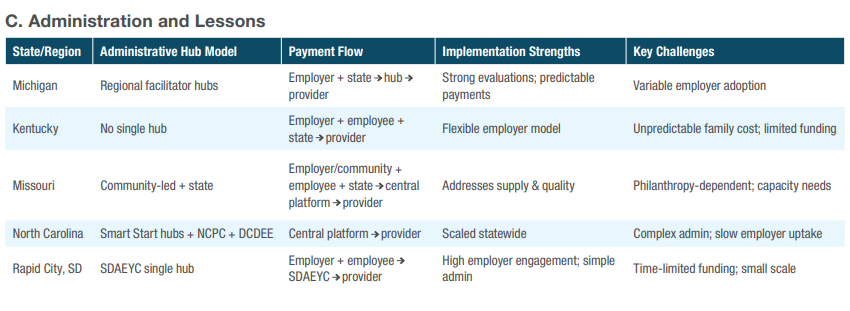
Improving the administration of child care benefits is valuable. I totally agree with Linda Smith that the are systems-level lessons to be learned, such as that “A centralized, well-funded, integrated administrative hub is essential,” and “Modern, integrated technology systems are critical to support multi-party transactions”. As the Buffett report shows, there are lessons that can apply far beyond Tri-Share:
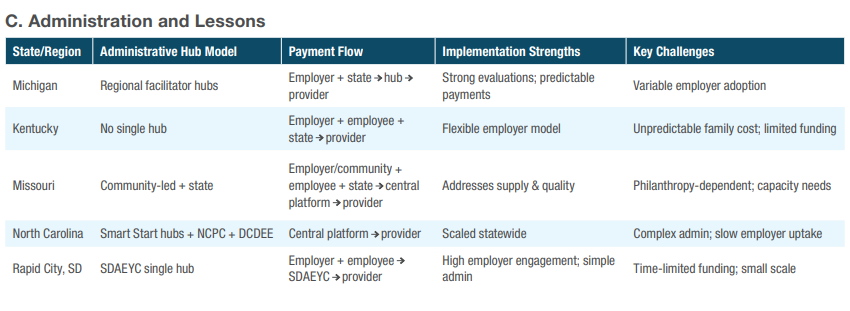
While I generally think that the more streamlined and simple a child care funding system can be, the better, it’s good to wrestle with these technical issues of implementation and administration. (And indeed, hats off to Tri-Share administrators who have spent many surely headache-inducing hours doing so!)
Child care programs need all the help they can get with recruiting and retaining their staff. The fact that child care programs themselves are eager to sign up for Tri-Share is notable. They’re struggling with staffing and need any publicly-funded aid they can get! While, as I’ve said, I don’t think Tri-Share is actually the best vehicle for this, it’s another good piece of evidence around staffing needs.
What do I want to see happen?
I’m going to be totally honest with you: I want to see existing Tri-Share initiatives given a much clearer ‘pre-registered’ set of growth metrics and a plan to phase out programs if they cannot come close to meeting them; for the Congressional legislation to go nowhere for the moment; and for new states and localities to stop adopting Tri-Share policies until and unless there is real evidence that this model works. Instead, I’d like to see government at all levels use that energy and time and money to, first and foremost, make child care free for all child care educators. It’s a near-peer policy that works, bolsters supply, and thus will have positive ripple effects on business’ workforce development.
Then, states should look to ways to leverage business funding to support the growth and sustainability of child care writ large. While ideally this would be done via corporate (or payroll) taxes, I think models like Iowa’s Child Care Solutions Fund can be viable as an ‘easy button.’ As The Century Foundation’s Lea Woods, a fellow Tri-Share skeptic, has explained:
Child care funds, which pool public and private investments, are increasingly popular means by which to pay for programs to help mitigate the child care crisis. One fund, Iowa’s Childcare Solutions Fund (CSF), implemented in 2024, was specifically designed to build child care supply. Like Michigan’s Tri-Share, it pools public and private funds and relies on a nonprofit to administer those funds … However, whereas Tri-Share funds are used to lower prices for families by dividing tuition among more payers, CSF fills the gap between the number of children who need care and the number of available child care slots by directly investing in new child care slots and programs and raising early educator wages to reduce turnover. Though the CSF does not directly subsidize child care tuition, the Iowa Area Women’s Foundation, a CSF partner, suggests that the CSF makes high-quality child care more affordable by raising the wages of qualified and passionate early educators without needing to raise prices for families.
The CSF pilot program made strides toward expanding child care capacity by starting to stem Iowa’s child care supply decline by adding 275 slots. The CSF is projected to add nearly 11,000 new registered or licensed child care slots if scaled statewide. This program offers a promising means of building much needed child care capacity.
Other locations, like Travis County (TX) and the state of Louisiana, have experimented with or planned child care funds that take in business dollars, match or multiply them with state/local dollars, and then leverage the money to build up supply or increase available subsidy scholarships. Child care funds aren’t perfect, but they’re another red-state-friendly option that evades much of the opportunity cost inherent in Tri-Share. It remains to be seen how scalable they are (and if they prove limited in appeal, then I would apply the same R&D analysis), but they appear to be a promising alternative.
I want to close by saying that reasonable people can reasonably disagree about Tri-Share. If it feels like I’m falling over myself to underline that point, there’s a reason, and I think it’s one worth naming: in a sector as marked by scarcity — and one as increasingly under attack from bad-faith actors — as child care, raising objections to a particular policy direction can cause an understandable defensiveness, or at least a worry over divisiveness. And yet, I think it is of the utmost importance that we be able to have open conversations about tradeoffs, opportunity costs, and the fact that there are better and worse paths to follow to reach our ultimate goal of a country where children, families, child care practitioners, and businesses can all thrive.
Total number of participating employers is not listed publicly, but was 35 in January 2024.
Michigan, helpfully, provides a database of all participating employers, so feel free to take a look. Also, Kentucky is an exception here for reasons I’ll explain in a moment.
See: Child care system, desperately underfunded
To help address this last point, Michigan recently started offering “CareShare,” which is essentially a ‘two-share’ system where employers cover 1/3 of costs and employees who make above the Tri-Share income limit cover 2/3 with the state not contributing, but employers can utilize the Tri-Share infrastructure to administer the benefit.
If I was offering the bull case for Tri-Share, I’d spotlight Missouri, where things seem to be going fairly well in the early rollout and where the model is a step more comprehensive than traditional Tri-Share.
Which is not all that big of a room to begin with!
Admittedly a crude measure, but I think it establishes the point.
While the replication crisis has improved some since it came to light in the late 2000s and early 2010s, a 2025 Nature article was entitled, “Researchers value null results, but struggle to publish them: Survey finds that fear of reputational harm and a lack of support and publication platforms are among respondents’ key concerns.”
Though those tax credits were made more generous in the 2025 GOP budget bill, so that’s another experiment to track!
We have a tri-share pilot in Ohio—Child Care Cred—with a 40/40/20 cost share (employer/employee/state) and a $10 million investment that must be spent by June 30, although we are working to get those dollars able to be spent in the next FY as well.
I deeply respect Linda, and I appreciate you capturing this full conversation. The ongoing tension is real: how do we engage new stakeholders and stay open to innovation without giving policymakers a menu that lets them choose the side dish instead of the main course? That challenge is compounded when uptake is slow and impact is hard to prove. More to be learned in the next year from Ohio.
Thank you for the in depth coverage of Tri Share. I agree it is a tool in a tool box. Some tools are useful in some situations. In WV, this legislative session Senator Oliverio introduced a Workforce Scholarahip Bill , modeled after Kentucky's success with boosting the childcare workforce. This boost in turn increased the workforce for all industries by increasing access to care. Instead of adding the projected $5.2 million to the state budget needed to implement this scholarship, , the choice was made to add an additional $5 million to the Tri-Share Pilot. These choices have consequences. You explained the scalability issue of Tri Share very well. (The overhead for administering this program through a third party vendor is also a concern). To truly impact affordability of childcare, there must be investments in the existing childcare infrastructure that is quickly collapsing. West Virgina has 325 less childcare providers now than in 2024. Childcare rates are rising due to underfunding in the childcare subsidy system. Investment is crutial AND ensuring that the investment is impactful is critical.